The impossible current (1962)
Established physics —
In 1962, a 22-year-old PhD student at Cambridge predicted something that sounded impossible: an electric current flowing through an insulator — with no voltage pushing it.
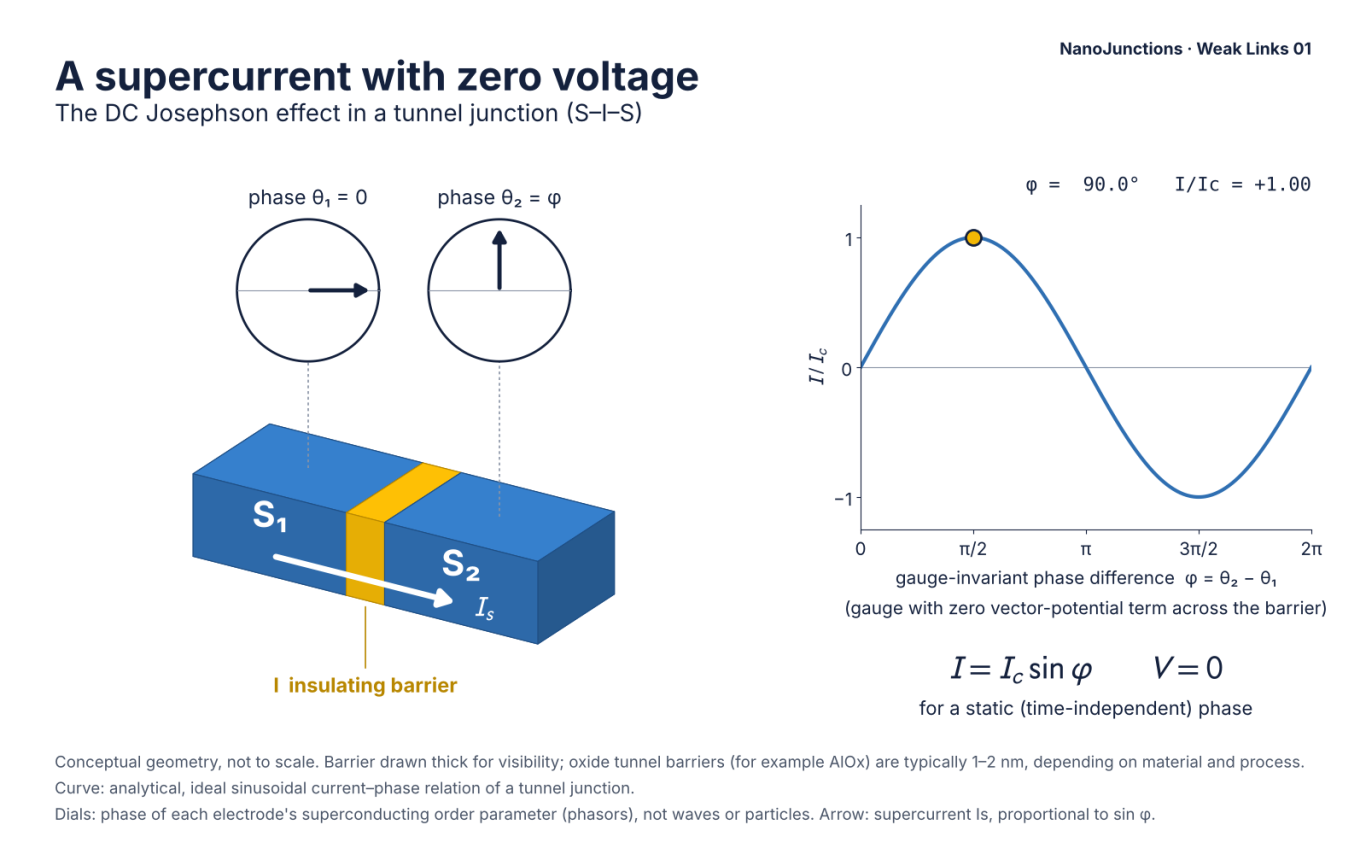
Brian Josephson was studying superconductors, materials in which electrons pair up and move as one quantum wave. He asked a simple question: if you put two superconductors on either side of a barrier thin enough for that wave to leak across, what happens?
His answer: a current flows anyway. No voltage, no resistance — just a current whose size depends on the difference in the quantum phase between the two sides. A piece of quantum mechanics you can wire into a circuit: I = Ic·sin(φ). The current is biggest when the two waves are a quarter-cycle out of step, and it stops when they are in step.
Physicists were skeptical. Within a year, the effect was confirmed in the lab by Philip Anderson and John Rowell. Josephson won the Nobel Prize in 1973.
The device that makes it happen
The device is called a weak link: the spot where two superconductors are only weakly connected — a thin insulating layer, a narrow bridge, a grain boundary. It is called weak because a small current is enough to push it out of its zero-voltage state. Above a certain current — the critical current — a voltage appears across the junction and the quantum phase starts to run. Nothing breaks: the junction is still there, unchanged, and if you lower the current it goes back to carrying current with no voltage at all. That sensitivity — a small push changes the state — is exactly the point: it makes the junction exquisitely sensitive to magnetic fields, to voltages, and to quantum states.
That sensitivity is why weak links run the world's voltage standard, the most sensitive magnetometers ever built, and the qubits in quantum computers. All of it from a 1962 idea about a leak in a wave.
Why this matters
Most people have never heard of the Josephson effect, yet it sits underneath some of the most precise instruments ever built. A voltage standard that never drifts. A magnetometer that can hear a brain think. A qubit that holds a quantum state. All three are the same device, doing the same trick: two superconductors, weakly connected, and a quantum phase doing the work.
What comes next
This is the first part of Weak Links, a short series on the weak link — the device, the physics, and the people who chased it. Next: what a weak link actually looks like — the thin barrier, the narrow bridge, the grain boundary — and why shaping that tiny spot is the whole game. [Episode 2: What a weak link actually is →]
References
- B. D. Josephson, "Possible new effects in superconductive tunnelling," Physics Letters 1, 251–253 (1962).
- P. W. Anderson and J. M. Rowell, "Probable observation of the Josephson superconducting tunneling effect," Physical Review Letters 10, 230–232 (1963).
- The Nobel Prize in Physics 1973 — press release and lecture, NobelPrize.org (Josephson, Esaki, Giaever).
- For the weak link in general: M. Tinkham, Introduction to Superconductivity, 2nd ed. (McGraw-Hill, 1996), Ch. 6; A. Barone and G. Paternò, Physics and Applications of the Josephson Effect (Wiley, 1982).
This article is part of the educational series "Weak Links" by NanoJunctions. It presents established physics. No research results of NanoJunctions are claimed here.